# Import or Create Shamir Backup

Keystone supports the importing and creation of SLIP39 Shamir Backups. To learn more about Shamir Backup, visit our [blog](https://blog.keyst.one/why-keystone-implemented-shamir-backups-71e319f972a6).

## **I. Preparation**

Setup the Keystone Essential or Pro and get into the \[Create/Import Wallet] page.

## **II. Steps**

\- Create a Wallet with Shamir Backup

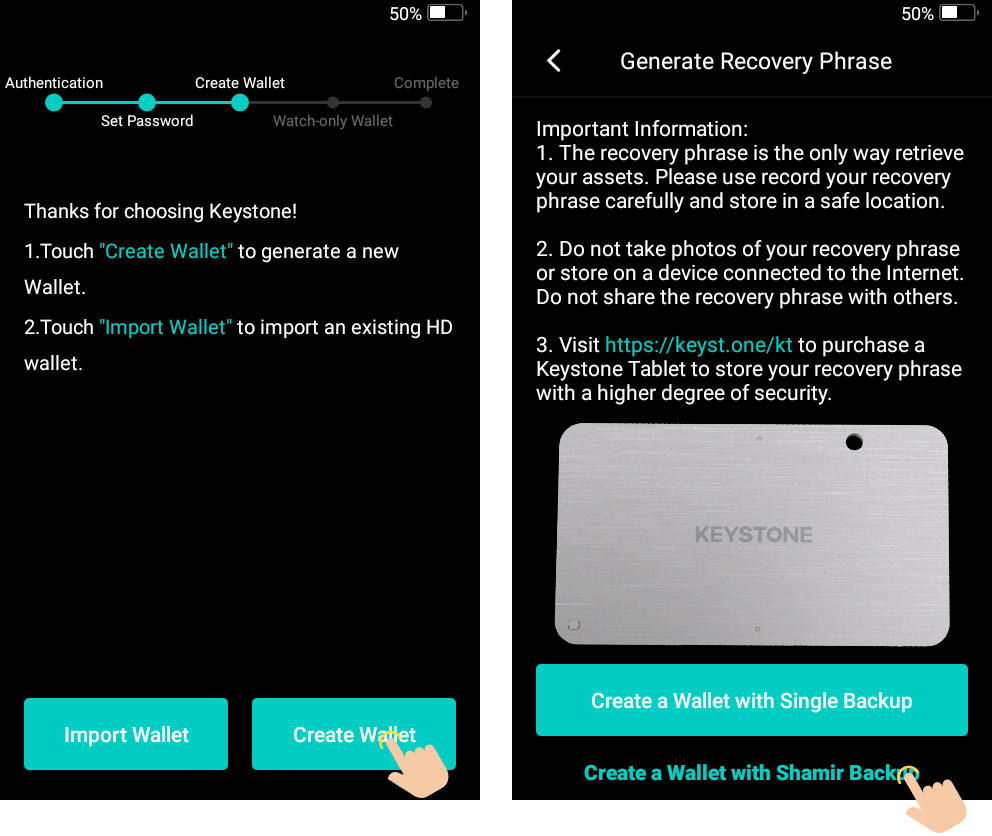
1\. Click \[Create Wallet] > \[Create a Wallet with Shamir Backup].

<figure><img src="https://2420738387-files.gitbook.io/~/files/v0/b/gitbook-legacy-files/o/assets%2F-MVozfoQsxc6YFPQfVTB%2F-MY2lXYeMRACwWhcsZL2%2F-MY3rxoItW5KFpDsO2SY%2F1.jpg?alt=media&#x26;token=f1a37381-95b7-40e2-a28f-88cb7e9a07f2" alt="Keystone-Shamir Backup-1"><figcaption></figcaption></figure>

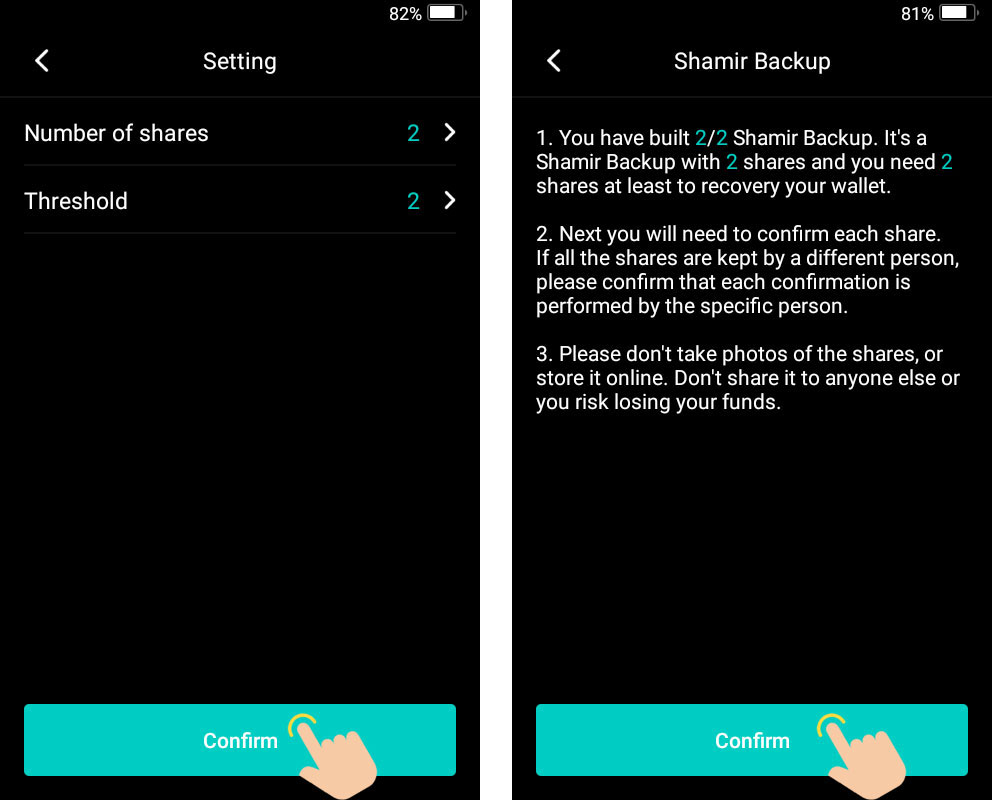
2\. Set the number of shares and treshold. Click \[Confirm]. Then read the security tips carefully and click \[Confirm].

<figure><img src="https://2420738387-files.gitbook.io/~/files/v0/b/gitbook-legacy-files/o/assets%2F-MVozfoQsxc6YFPQfVTB%2F-MY2lXYeMRACwWhcsZL2%2F-MY3t6ivq60ft0Z-s21u%2F2.jpg?alt=media&#x26;token=a3922139-fbfb-4b06-8daf-8a05b7f190af" alt="Keystone-Shamir Backup-2"><figcaption></figcaption></figure>

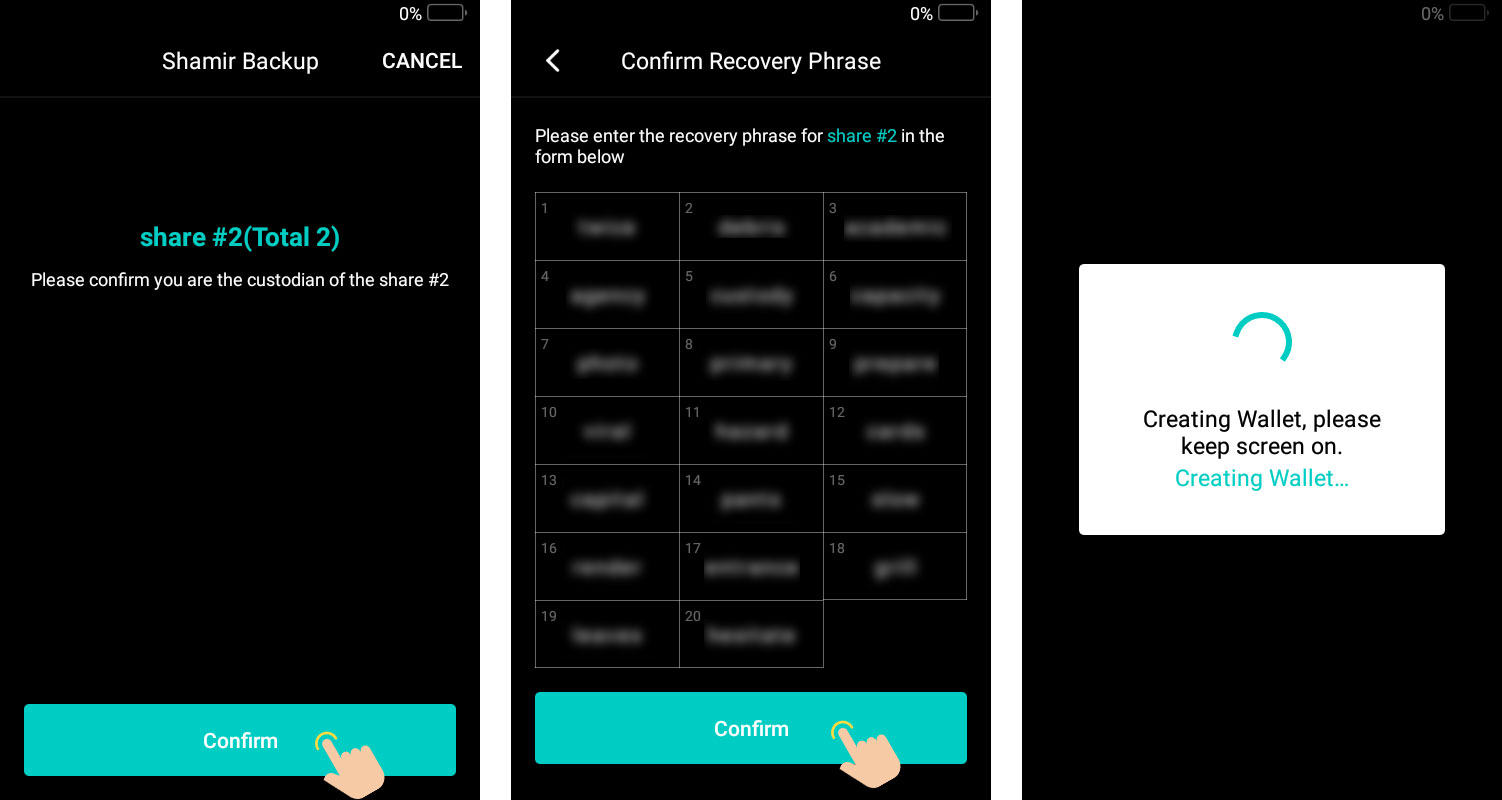
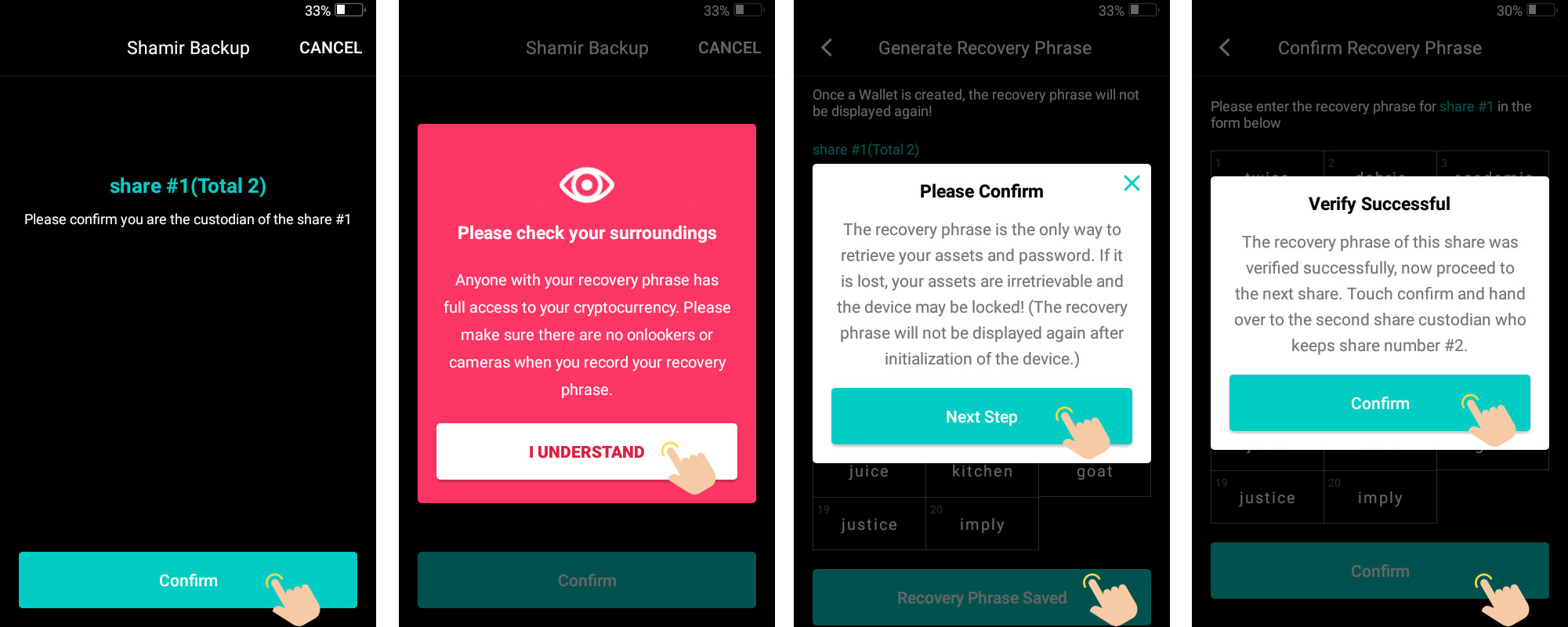
3\. Custodians can start to back up the shares one by one. Click \[Confirm] > \[I UNDERSTOOD] > write down the share and click \[Recovery Phrase Saved] > \[Next Step] > Verify the backup and click \[Confirm] > \[Confirm] > give the device to the next custodian.

<figure><img src="https://2420738387-files.gitbook.io/~/files/v0/b/gitbook-legacy-files/o/assets%2F-MVozfoQsxc6YFPQfVTB%2F-MY2lXYeMRACwWhcsZL2%2F-MY3u3knk8sANywkaHr8%2F4.jpg?alt=media&#x26;token=a081f86a-df95-46f8-bd75-b027a7a1f022" alt="Keystone-Shamir Backup-3"><figcaption></figcaption></figure>

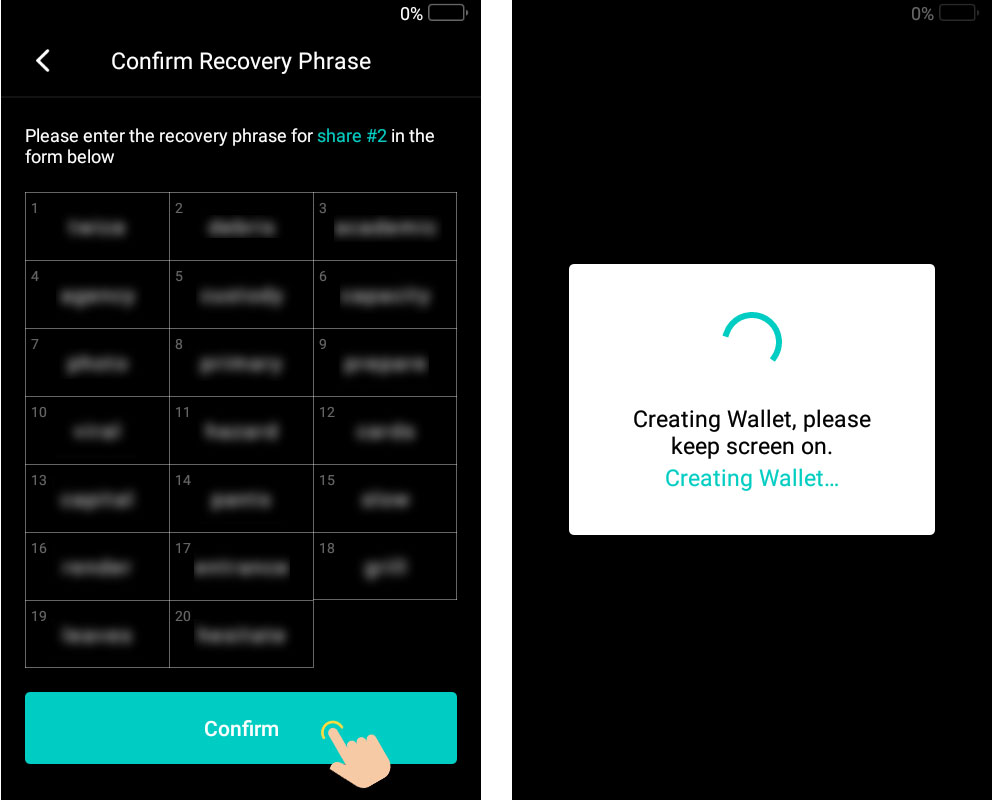
4\. Repeat step 3. When the last custodian completes the backup and clicks \[Confirm], the Keystone will start to create a Wallet with the Shamir backup.

<figure><img src="https://2420738387-files.gitbook.io/~/files/v0/b/gitbook-legacy-files/o/assets%2F-MVozfoQsxc6YFPQfVTB%2F-MY2lXYeMRACwWhcsZL2%2F-MY3yiLTnbJy1gbE7JfG%2F5.jpg?alt=media&#x26;token=93bc6aca-aea5-40a2-93d8-d0b9b923d5f8" alt="Keystone-Shamir Backup-4"><figcaption></figcaption></figure>

\- Import a Wallet with Shamir Backup

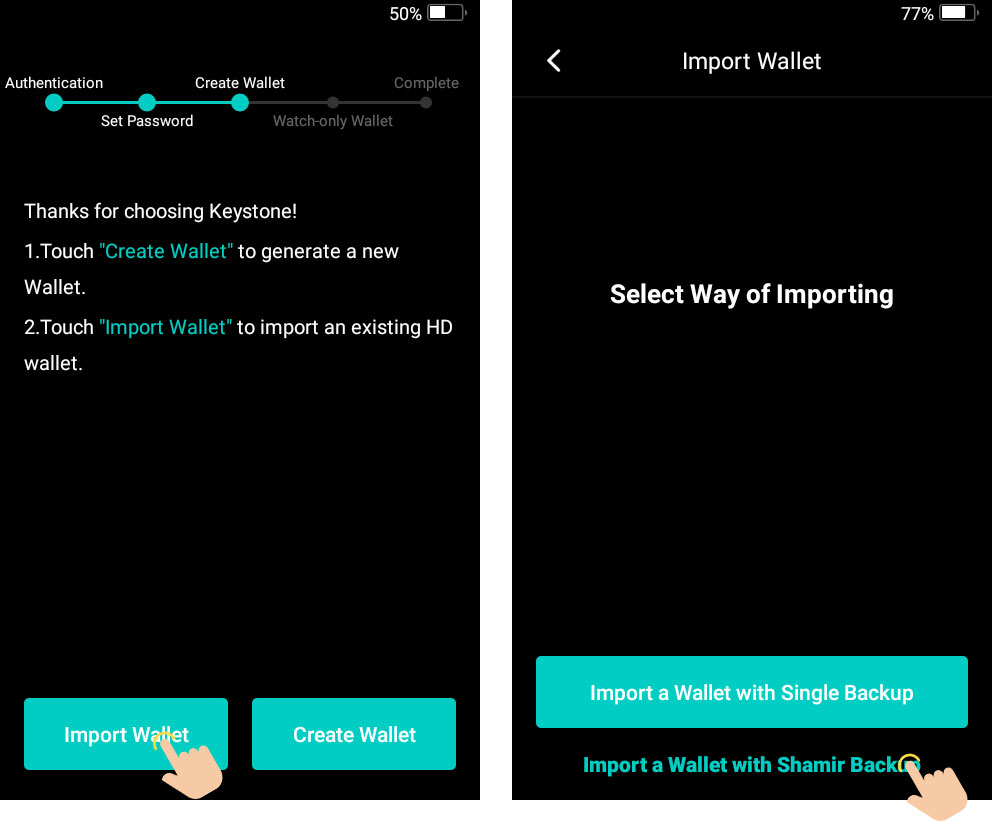
1\. Click \[Import Wallet] > \[Import a Wallet with Shamir Backup].

<figure><img src="https://2420738387-files.gitbook.io/~/files/v0/b/gitbook-legacy-files/o/assets%2F-MVozfoQsxc6YFPQfVTB%2F-MY2lXYeMRACwWhcsZL2%2F-MY3yxx5tmFYQr6_v18V%2F6.jpg?alt=media&#x26;token=5681a36e-94c2-4343-9665-6af341c2b636" alt="Keystone-Shamir Backup-5"><figcaption></figcaption></figure>

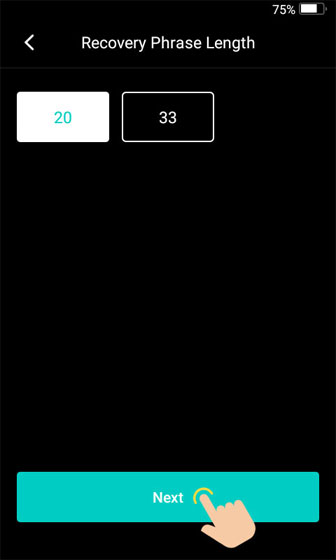
2\. Select recovery phrase length and click \[Next].

<figure><img src="https://2420738387-files.gitbook.io/~/files/v0/b/gitbook-x-prod.appspot.com/o/spaces%2FrQXQQRT6etffwhkFpfZG%2Fuploads%2FR5dZ340FeeMeRKOXXl7o%2F7-%E7%BC%A9%E5%B0%8F70%25.jpg?alt=media&#x26;token=dff58368-558b-43ed-b1f0-249defb48e1f" alt="Keystone-Shamir Backup-6"><figcaption></figcaption></figure>

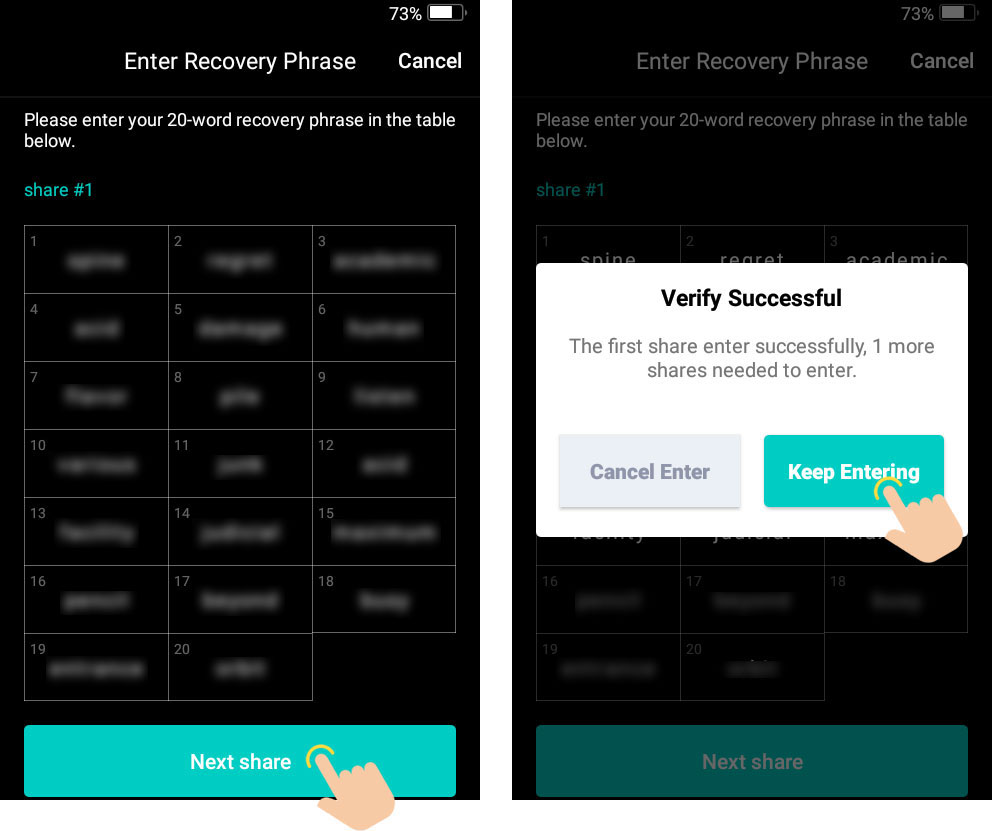
3\. Custodians can start to import shares one by one. Input share and click \[Next share] > \[Confirm].

<figure><img src="https://2420738387-files.gitbook.io/~/files/v0/b/gitbook-legacy-files/o/assets%2F-MVozfoQsxc6YFPQfVTB%2F-MY2lXYeMRACwWhcsZL2%2F-MY4-XH92SSWS1Vw8N7n%2F8.jpg?alt=media&#x26;token=b3d84a4c-60ba-4a12-97f1-774f70638713" alt="Keystone-Shamir Backup-7"><figcaption></figcaption></figure>

4\. When the last custodian completes the importing phase and clicks \[Next share], the Keystone will start to import a Vault with the Shamir backup.

<figure><img src="https://2420738387-files.gitbook.io/~/files/v0/b/gitbook-legacy-files/o/assets%2F-MVozfoQsxc6YFPQfVTB%2F-MY2lXYeMRACwWhcsZL2%2F-MY4-ZqmzKWNEbl8JTke%2F9.jpg?alt=media&#x26;token=a6e2e343-ad10-44a7-b2cc-6e013af2bb8f" alt="Keystone-Shamir Backup-8"><figcaption></figcaption></figure>

{% hint style="info" %}
If everything went fine, you should have the Wallet loaded with a Shamir backup!
{% endhint %}
---

# Agent Instructions: Querying This Documentation

If you need additional information that is not directly available in this page, you can query the documentation dynamically by asking a question.

Perform an HTTP GET request on the current page URL with the `ask` query parameter:

```
GET https://support.keyst.one/advanced-features/recovery-phrase/import-or-create-shamir-backup.md?ask=<question>
```

The question should be specific, self-contained, and written in natural language.
The response will contain a direct answer to the question and relevant excerpts and sources from the documentation.

Use this mechanism when the answer is not explicitly present in the current page, you need clarification or additional context, or you want to retrieve related documentation sections.