# Wasabi Wallet

Keystone firmware versions V1.1.1 (BTC-Only) or newer allows you to use Wasabi Wallet V1.1.12.8 or newer as a watch-only wallet.&#x20;

## **I. Preparation**

1\. [Firmware](https://keyst.one/firmware?locale=en) version V1.1.1 (BTC-Only) or newer running on Keystone Essential or Pro.&#x20;

&#x20;  (Please read[ How to upgrade firmware](https://support.keyst.one/getting-started/firmware-upgrading) for more details.)

2\. Computer with [Wasabi Wallet](https://wasabiwallet.io/#download) V1.1.12.8 or newer downloaded.

3\. MicroSD card (FAT32 format with capacity **NOT** exceeding 512GB).

{% content-ref url="../../getting-started/firmware-upgrading/how-to-format-a-microsd-card-to-fat32" %}
[how-to-format-a-microsd-card-to-fat32](https://support.keyst.one/getting-started/firmware-upgrading/how-to-format-a-microsd-card-to-fat32)
{% endcontent-ref %}

## II. Creating a Wasabi Wallet Watch-Only Wallet (BTC-Only)

1\. Insert your microSD card into Keystone.

2\. In the Keystone hardware wallet, go to\[Menu] > \[Settings] > \[Watch-Only Wallet] > \[Wasabi Wallet] > \[Confirm].

<figure><img src="https://2420738387-files.gitbook.io/~/files/v0/b/gitbook-legacy-files/o/assets%2F-MVozfoQsxc6YFPQfVTB%2F-Mabv63vXDe8oqyZ6PtG%2F-Mabze1Tm0VHLQJHuttn%2F1.jpg?alt=media&#x26;token=5b5b3690-d55b-4cff-87fe-61fb0e2d5fb8" alt="Keystone-Wasabi-1"><figcaption></figcaption></figure>

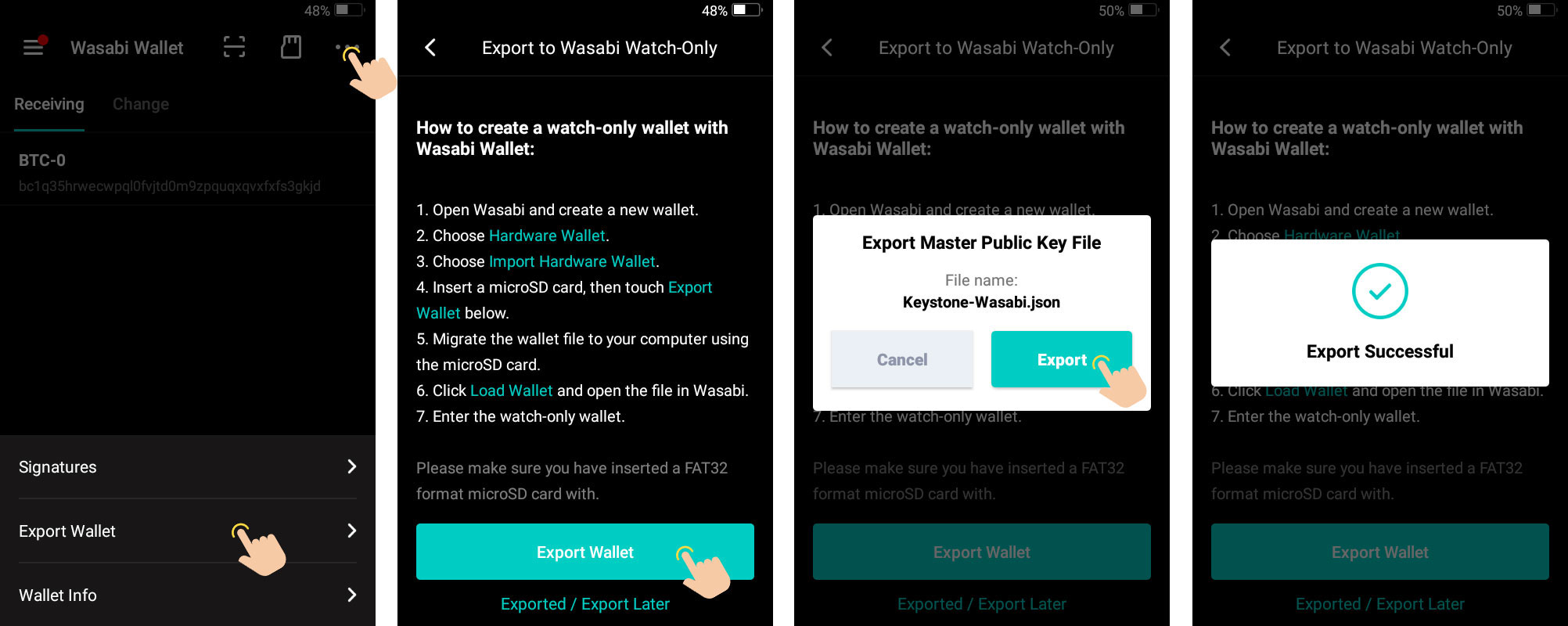
3\. Touch \[•••] > \[Export Wallet] > \[Export]. Your wallet's master public key file will be exported to the microSD card.

<figure><img src="https://2420738387-files.gitbook.io/~/files/v0/b/gitbook-legacy-files/o/assets%2F-MVozfoQsxc6YFPQfVTB%2F-Me-EMvSHGCVct8rNMOB%2F-Me-ESrcmedIriAhiy0A%2F2.jpg?alt=media&#x26;token=a2b8c27c-e72f-404e-8b04-38ba78084409" alt="Keystone-Wasabi-2"><figcaption></figcaption></figure>

4\. Take the microSD card out of Keystone and insert it into your computer.

5\. Open Wasabi Wallet on your computer, select \[Hardware Wallet] > \[Import Coldcard].

<figure><img src="https://2420738387-files.gitbook.io/~/files/v0/b/gitbook-legacy-files/o/assets%2F-MVozfoQsxc6YFPQfVTB%2F-MafnZ1ucS-n5gBs8gTT%2F-MagQ-a8IyHDX5Jcl5Cp%2F3.jpg?alt=media&#x26;token=18b60bc6-aef4-410b-b151-278bea6988c0" alt="Keystone-Wasabi-3"><figcaption></figcaption></figure>

6\. In the root directory of the microSD card, find the Xpub file and click \[Open].

<figure><img src="https://2420738387-files.gitbook.io/~/files/v0/b/gitbook-legacy-files/o/assets%2F-MVozfoQsxc6YFPQfVTB%2F-MafnZ1ucS-n5gBs8gTT%2F-MagQ40X_IU1cERWge_F%2F4.jpg?alt=media&#x26;token=a3a4bd8d-1489-4af9-a457-53b5e3ceeaa0" alt="Keystone-Wasabi-4"><figcaption></figcaption></figure>

7\. Click \[Load Wallet].

<figure><img src="https://2420738387-files.gitbook.io/~/files/v0/b/gitbook-legacy-files/o/assets%2F-MVozfoQsxc6YFPQfVTB%2F-MafnZ1ucS-n5gBs8gTT%2F-MagQI1O4bD-kJ2xX_dl%2F5.jpg?alt=media&#x26;token=dab39f3e-3370-416a-a8c3-00f9a8460f0d" alt="Keystone-Wasabi-5"><figcaption></figcaption></figure>

8\. Wasabi can now be used as the watch-only wallet for Keystone.&#x20;

<figure><img src="https://2420738387-files.gitbook.io/~/files/v0/b/gitbook-legacy-files/o/assets%2F-MVozfoQsxc6YFPQfVTB%2F-MafnZ1ucS-n5gBs8gTT%2F-MagQDlSjZjzyrz44aZ_%2F6.jpg?alt=media&#x26;token=bac27076-4dba-42a6-a94c-e762e87326b0" alt="Keystone-Wasabi-6"><figcaption></figcaption></figure>

<figure><img src="https://2420738387-files.gitbook.io/~/files/v0/b/gitbook-legacy-files/o/assets%2F-MVozfoQsxc6YFPQfVTB%2F-MafnZ1ucS-n5gBs8gTT%2F-MagQMs9bYACrOQBpM-7%2F7.jpg?alt=media&#x26;token=44375162-d06a-4422-bf7f-ed773c6255ea" alt="Keystone-Wasabi-7"><figcaption></figcaption></figure>

## II. Sending and Receiving Assets with Wasabi Wallet

### **A. Receiving Bitcoin**&#x20;

You can use receiving addresses displayed by either the Keystone hardware wallet or Wasabi to receive bitcoin.&#x20;

1\. Displaying Address on Keystone

&#x20;1\) On the Keystone hardware wallet, go to \[Settings] > \[Watch-Only Wallet] > \[Wasabi Wallet].

&#x20;2\) Once you enter your Wasabi Wallet interface on Keystone, touch a receiving address to display it as a QR code.

<figure><img src="https://2420738387-files.gitbook.io/~/files/v0/b/gitbook-legacy-files/o/assets%2F-MVozfoQsxc6YFPQfVTB%2F-Makhfwy5f7dghQxYoPs%2F-MalQf6JI2DcK9pIykR8%2F1.jpg?alt=media&#x26;token=f8656172-1134-41cd-ab63-0f8fcfa82e22" alt="Keystone-Wasabi-8"><figcaption></figcaption></figure>

2\. Displaying Addresses on Wasabi Wallet

1\) Click \[Receive] to display receiving addresses.

<figure><img src="https://2420738387-files.gitbook.io/~/files/v0/b/gitbook-legacy-files/o/assets%2F-MVozfoQsxc6YFPQfVTB%2F-Makhfwy5f7dghQxYoPs%2F-MalQj_k4cmIgPtxlyIE%2F2.jpg?alt=media&#x26;token=b53c866a-5470-4623-bf50-432d50ed8319" alt="Keystone-Wasabi-9"><figcaption></figcaption></figure>

### **B. Sending Bitcoin**

1\. Using Wasabi Wallet to Send Bitcoin

1\) Insert your microSD card into your computer while running Wasabi Wallet.

2\) Click on \[Build Transaction] on the right side navigation bar.

3\) Select the UTXOs you want to use, then configure the receiving address, transaction amount, and transaction fees.

4\) Click \[Build Transaction] in the bottom left of the interface, and check the signed transaction data.&#x20;

<figure><img src="https://2420738387-files.gitbook.io/~/files/v0/b/gitbook-legacy-files/o/assets%2F-MVozfoQsxc6YFPQfVTB%2F-Makhfwy5f7dghQxYoPs%2F-MalVkqp31GByLdp_WN2%2F3.jpg?alt=media&#x26;token=25f83b35-a0e1-4e98-9698-a72bfb056ca3" alt="Keystone-Wasabi-10"><figcaption></figcaption></figure>

<figure><img src="https://2420738387-files.gitbook.io/~/files/v0/b/gitbook-legacy-files/o/assets%2F-MVozfoQsxc6YFPQfVTB%2F-Makhfwy5f7dghQxYoPs%2F-MalVoxW6Yj2pWKRX5BA%2F4.jpg?alt=media&#x26;token=a6e92567-d677-4dfa-863f-29119538a902" alt="Keystone-Wasabi-11"><figcaption></figcaption></figure>

<figure><img src="https://2420738387-files.gitbook.io/~/files/v0/b/gitbook-legacy-files/o/assets%2F-MVozfoQsxc6YFPQfVTB%2F-Makhfwy5f7dghQxYoPs%2F-MalVt2zCAo8OLZ_1A9a%2F4-1.jpg?alt=media&#x26;token=5873d8bf-db62-4f5f-9a8c-cc72c9c63b62" alt="Keystone-Wasabi-12"><figcaption></figcaption></figure>

5\) Click \[Export Transaction] in the lower right corner to export the PSBT file to your microSD card.

<figure><img src="https://2420738387-files.gitbook.io/~/files/v0/b/gitbook-legacy-files/o/assets%2F-MVozfoQsxc6YFPQfVTB%2F-Makhfwy5f7dghQxYoPs%2F-MalW4wyFOjVTX4uQyrt%2F5-1.jpg?alt=media&#x26;token=c244059f-5458-423e-a147-bf8cb2665012" alt="Keystone-Wasabi-13"><figcaption></figcaption></figure>

<figure><img src="https://2420738387-files.gitbook.io/~/files/v0/b/gitbook-legacy-files/o/assets%2F-MVozfoQsxc6YFPQfVTB%2F-Makhfwy5f7dghQxYoPs%2F-MalWB8QoPbhu2lN9pwc%2F5-2.jpg?alt=media&#x26;token=0dfca6b8-6cc2-48d3-8218-61f299402c7e" alt="Keystone-Wasabi-14"><figcaption></figcaption></figure>

<figure><img src="https://2420738387-files.gitbook.io/~/files/v0/b/gitbook-legacy-files/o/assets%2F-MVozfoQsxc6YFPQfVTB%2F-Makhfwy5f7dghQxYoPs%2F-MalWFZmeqlrefeZh_1T%2F5-3.jpg?alt=media&#x26;token=9411aad3-206e-47c9-9687-73ce58ff9526" alt="Keystone-Wasabi-15"><figcaption></figcaption></figure>

2\. Using Keystone Hardware Wallet to Sign Transactions

1\) Take out the microSD card from computer and insert it into Keystone.

2\) Touch "MicroSD card" icon, and open the transaction file.

<figure><img src="https://2420738387-files.gitbook.io/~/files/v0/b/gitbook-legacy-files/o/assets%2F-MVozfoQsxc6YFPQfVTB%2F-Makhfwy5f7dghQxYoPs%2F-MalevNedETZr7gUwVWa%2F6.jpg?alt=media&#x26;token=3eb5cdc1-97e7-49a0-8a26-300e0a7cf14b" alt="Keystone-Wasabi-16"><figcaption></figcaption></figure>

3\) Touch \[Sign] and enter your password to sign the transaction.

<figure><img src="https://2420738387-files.gitbook.io/~/files/v0/b/gitbook-legacy-files/o/assets%2F-MVozfoQsxc6YFPQfVTB%2F-Makhfwy5f7dghQxYoPs%2F-MalezrhF7ZzK56E_RW3%2F7.jpg?alt=media&#x26;token=23341e90-3f12-48f3-9460-c50d3d8bfc1a" alt="Keystone-Wasabi-17"><figcaption></figcaption></figure>

4\) Touch \[Export] and the signed PSBT transaction file (awaiting broadcast) will be exported to your MicroSD card's root directory.

<figure><img src="https://2420738387-files.gitbook.io/~/files/v0/b/gitbook-legacy-files/o/assets%2F-MVozfoQsxc6YFPQfVTB%2F-Makhfwy5f7dghQxYoPs%2F-Malf4cUM2M8WiemmGnm%2F8.jpg?alt=media&#x26;token=b7d2171a-151a-407d-9d54-08586bb3aa61" alt="Keystone-Wasabi-18"><figcaption></figcaption></figure>

3\. Using Wasabi to Broadcast Transactions

1\) Take the microSD card out of Keystone and insert it into your computer.

2\) In Wasabi, click \[Open Transaction Broadcaster] > \[Import Transaction]. Find out the signed transaction file under the microSD card and open it. Click \[Broadcast Transaction] to broadcast the transaction.

<figure><img src="https://2420738387-files.gitbook.io/~/files/v0/b/gitbook-legacy-files/o/assets%2F-MVozfoQsxc6YFPQfVTB%2F-Makhfwy5f7dghQxYoPs%2F-MalgqYz6tiaTybC3upw%2F9-1.jpg?alt=media&#x26;token=07264296-ea5b-4970-9b6c-e78df905a521" alt="Keystone-Wasabi-19"><figcaption></figcaption></figure>

<figure><img src="https://2420738387-files.gitbook.io/~/files/v0/b/gitbook-legacy-files/o/assets%2F-MVozfoQsxc6YFPQfVTB%2F-Makhfwy5f7dghQxYoPs%2F-MalgtqRgnLOJvNRnPzI%2F9-2.jpg?alt=media&#x26;token=abfd90d2-cc6c-4b7f-9f1f-ede969e38b43" alt="Keystone-Wasabi-20"><figcaption></figcaption></figure>

<figure><img src="https://2420738387-files.gitbook.io/~/files/v0/b/gitbook-legacy-files/o/assets%2F-MVozfoQsxc6YFPQfVTB%2F-Makhfwy5f7dghQxYoPs%2F-Malhlq5WQROUTH-PrMG%2F9-3-1.jpg?alt=media&#x26;token=58fbf480-281b-4ed2-9722-704807fc6271" alt="Keystone-Wasabi-21"><figcaption></figcaption></figure>

<figure><img src="https://2420738387-files.gitbook.io/~/files/v0/b/gitbook-legacy-files/o/assets%2F-MVozfoQsxc6YFPQfVTB%2F-Makhfwy5f7dghQxYoPs%2F-MalhTwWrxtRbH7P74qC%2F9-3-2.jpg?alt=media&#x26;token=17263591-668c-451c-8b9e-3709e046202c" alt="Keystone-Wasabi-22"><figcaption></figcaption></figure>


---

# Agent Instructions: Querying This Documentation

If you need additional information that is not directly available in this page, you can query the documentation dynamically by asking a question.

Perform an HTTP GET request on the current page URL with the `ask` query parameter:

```
GET https://support.keyst.one/3rd-party-wallets/bitcoin-wallets/wasabi.md?ask=<question>
```

The question should be specific, self-contained, and written in natural language.
The response will contain a direct answer to the question and relevant excerpts and sources from the documentation.

Use this mechanism when the answer is not explicitly present in the current page, you need clarification or additional context, or you want to retrieve related documentation sections.
